

AI engineering roadmap for beginners: With recommended resources


November 10, 2025

Breaking into AI engineering can be confusing.
- There is so much to learn
- And it is not always clear where to start or which resources to trust
That is why we created this roadmap; a structured guide that takes you from the very basics to building real-world AI applications. It is written with absolute beginners in mind but goes beyond surface-level concepts. Every step has been reviewed by an industry veteran, so what you are learning reflects how AI engineering is practiced in the real world.
In each step, we don’t just explain what to learn, we also break down why it matters, and where to find credible resources. But first…
Who is an AI engineer?
The misconception we commonly see is in authors describing an ML engineer as an AI engineer, which often leads to the wrong roadmap. Essentially, they focus on different layers of the AI stack. Let’s clarify the difference.
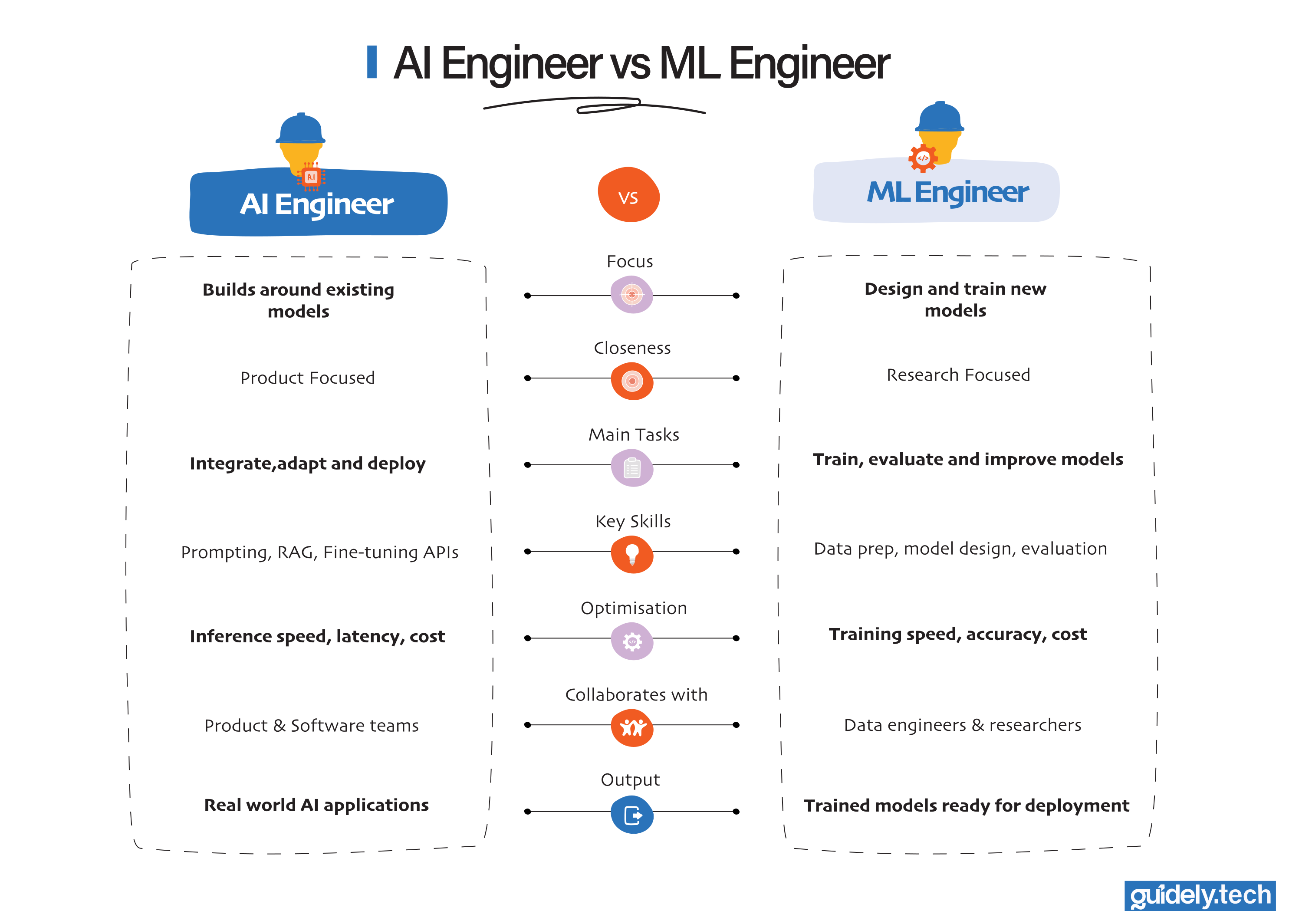
AI engineers
AI engineers build around models designed by ML engineers. They connect pre-trained foundation models (like GPT-4) to applications and adapt them using prompt engineering, RAG, and fine-tuning. They’re closer to product.
Furthermore, AI engineers often work with large models that are compute-intensive and latency-sensitive, so they have to think carefully about making model usage efficient. Or more technically, for AI engineers, there is constant pressure to reduce inference and adaptation cost through techniques like prompt design, caching and model selection amongst others.
ML engineers
ML engineers on the other hand, work inside the models; training, improving, and designing them. They’re closer to research.
While ML engineers also deal with efficiency concerns, it’s usually about training efficiency; how to make the learning process faster and less costly.
ML engineers often work closely with data engineers and must understand dataset engineering fundamentals. They run experiments to select the best modelling approach and evaluate the model. Even though they may be closer to research, it is also common for ML engineers to package the code into production-grade code.
Both are vital, but this roadmap focuses on the AI engineer.
Entry point
AI engineering builds on software engineering. If you’re new, start here:
- Learn a programming language (Python, including creating and managing Python virtual environments)
- Understand Git & version control
- Learn about APIs and how services communicate
- Learn deployment with containers
- The fundamentals of working in the command line
If you already code, you can jump straight into the roadmap below.
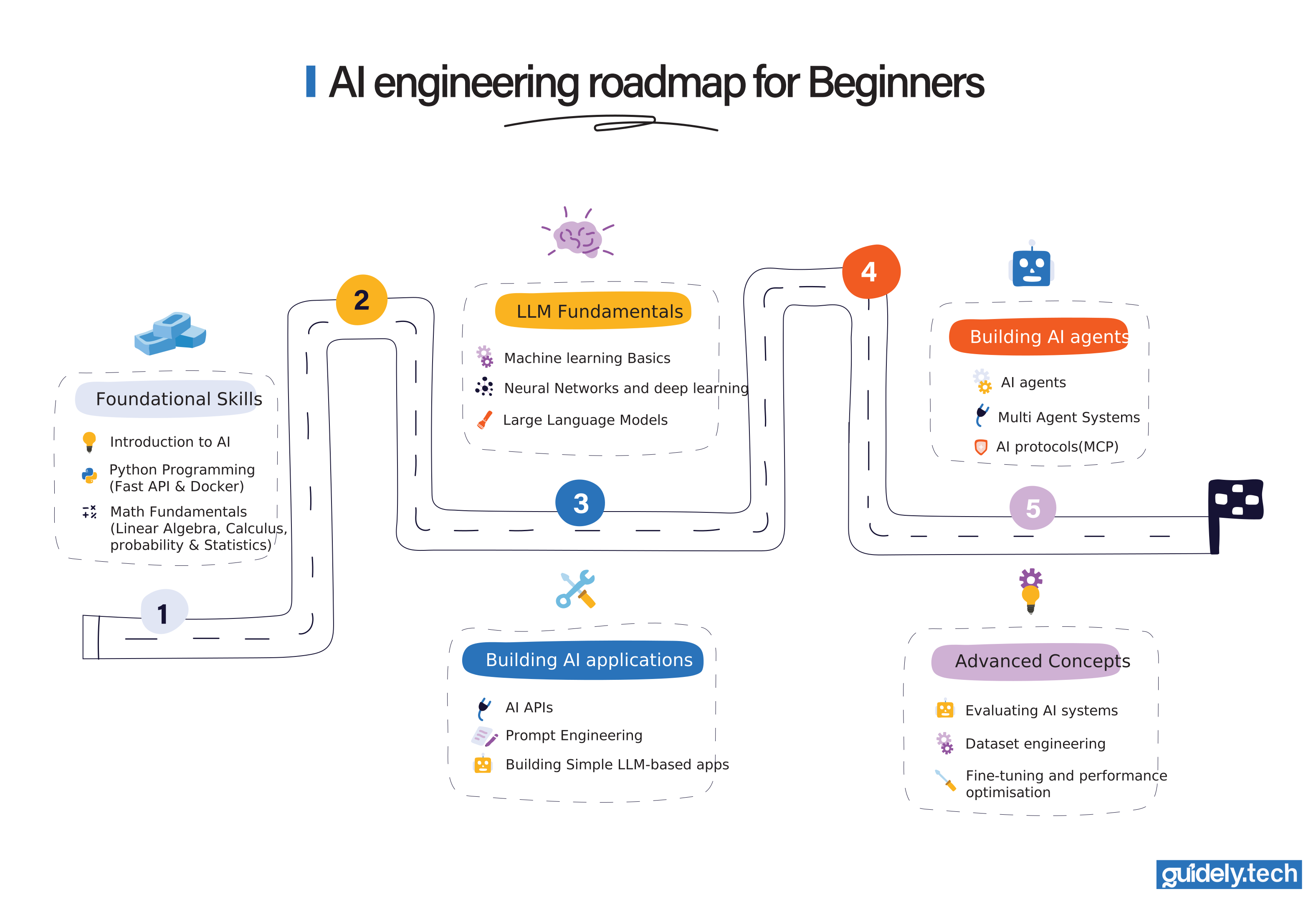
Phase 1: Foundational skills
This phase helps you build the right foundation. You will understand how AI works at a high level and get comfortable with the math and programming that every future step builds on. Yes, as an AI engineer your primary responsibility is not to design and create models, but here is the truth: you cannot build confidently on something you do not understand.
It is the difference between pressing buttons and understanding the machine.
Introduction to AI
Understand the big picture and the key concepts that define the field.
Python programming
Your core tool for building AI systems.
Paid alternatives
- Introduction to Computer Science and Programming - edX MITx
- Introduction to Computational Thinking and Data Science - edX MITx
Mathematics fundamentals
Focus on Linear Algebra, Calculus, Probability, and Statistics.
- Essence of Linear Algebra – 3Blue1Brown
- Essence of Calculus – 3Blue1Brown
- Probability Explained – Khan Academy
- Statistics Fundamentals – Khan Academy
Phase 2: LLMs fundamentals
At this stage, you start connecting the dots. You will see how machine learning algorithms evolve into deep learning, and how deep learning gives rise to large language models. Again, the more you understand the internals of these models, the better you can guide them.
Machine learning basics
No need going deep here.
Neural networks and deep learning
Understand how these models learn from data and build your first neural network from scratch.
Large language models (LLMs)
Explore how modern systems like GPT and Claude are built.
Phase 3: Build your first AI applications
Theory is essential, but real understanding comes from building. The goal here is to learn how to integrate AI into real-world systems confidently. You will experiment with APIs, prompts, and pre-trained models to see how all the pieces come together.
Start with AI APIs
Connect to powerful pre-trained models using services like OpenAI.
Learn prompt engineering
Mastering how to communicate with models determines the quality of your results.
Build simple LLM based applications
Build simple apps on top of LLMs. Connect LLMs to your own data using vector databases and embeddings.
- Build a Retrieval Augmented Generation (RAG) App - LangChain
- Short-term memory - LangChain
- Long-term memory - LangChain
Phase 4: Building AI agents
AI agents are where things get exciting. They can act, reason, and make decisions autonomously. This phase introduces you to multi-agent systems and how to design workflows where multiple AI components collaborate.
Building AI Agents
AI protocols — MCP
Phase 5: Advanced concepts
With a strong foundation and some hands-on projects under your belt, it’s only natural to start pushing further towards professional AI engineering.
To do so, you will want to build reliable AI systems. This means answering questions like “Which tasks can my agent solve, and where does it struggle?” or “Is my new prompt better?” or “Is it helpful enough so we can confidently show it to users?” This is when AI engineers establish systematic evaluation methods, which for LLM-based applications are challenging given they produce open-ended responses. Traditional machine learning and natural language processing metrics often fall short, and often teams must employ a mix of automated evaluation metrics, LLM-as-a-Judge, and human evaluation to build highly reliable AI systems.
To have a well-oiled engineering process, you will want to use a dedicated tool to trace inputs and outputs from your AI system, manage prompt versions, datasets, and evaluation experiments. For instance, this open-source LLM engineering platform: https://langfuse.com/
Evaluating AI systems
Dataset engineering
To support evaluation, it is common to collect examples of high-quality correct interactions. Depending on your application, this can be a very long and tedious process as you have to potentially ask for feedback from subject matter experts (think radiologists, spacecraft operators).
Beyond evaluation, you may want to create a dataset to fine-tune an open-source LLM to boost performance: learn new jargon, new vocabulary, or a behaviour specific to your use case. It is possible to start from existing datasets, to augment an existing dataset by rephrasing, to synthesize examples from seed examples, or to create a full human annotation campaign. The following resources are helpful in these situations:
A word of encouragement
Breaking into a new field, or just learning something new, can be humbling at first. I’ve been there before, but I often remind myself that if I just keep going, I’ll eventually cross that threshold where things finally start to fall into place. James Clear calls this threshold the Plateau of Latent Potential; that tipping point where all the unseen effort finally turns into visible progress. Just start and keep going!
Conclusion
This roadmap is a foundation, not a finish line. The path of an AI engineer is one of continual learning.
At Guidely, we are creating guides that make breaking into AI so much easier. Our mission is simple, but powerful: Create a community for anyone who’s ever felt “AI is too complex.”
I love this! How can I thank the authors?
Skip to
Enjoyed the read? Help us spread the word — say something nice!